
Split the loan
Your lender divides the home loan into separate accounts. The main one stays as it is. A second split is created for the amounts you will recycle.
Debt recycling gradually converts the debt on your home, which earns you no deduction, into debt used for investing, which generally does. The structure of your loan decides whether it works.

Interest on the loan over the home you live in is not deductible. You pay it out of after-tax income, and it buys you nothing at tax time.
Interest on money borrowed to produce assessable income, such as dividends or rent, is generally deductible against that income.
So a household can be paying interest on a large non-deductible loan while also putting spare cash into that same mortgage. Debt recycling asks whether some of that money could be doing two jobs instead of one.
It is not borrowing extra. Done properly your total debt does not rise. You pay down part of the home loan, then redraw that same amount for investing. The balance is the same. Its purpose, and therefore its tax treatment, is not.
The order matters. Pay down, then redraw, then invest, with the money going straight from the loan to the investment.
Your lender divides the home loan into separate accounts. The main one stays as it is. A second split is created for the amounts you will recycle.
You put surplus money into the investment split, reducing its balance.
You draw the same amount back out and use it to buy income-producing investments, with the funds going straight from the loan to the investment.
Investment income, any tax refund and your usual surplus go back into the non-deductible home loan. Over time the deductible portion grows.
The concept is simple to explain. Getting the loan to support it, cleanly, for a decade, is the work. This is the part we handle.
You need the loan divided into separate accounts, ideally without a fee for each new split. Some lenders cap how many you can have.
After paying down a split you need to draw the same amount back out, cleanly, straight to the investment rather than through your everyday account.
The investment split is for investment borrowings and nothing else. One personal draw turns it into a mixed loan that must be apportioned for years.
At tax time your accountant wants interest charged on each split separately. Not every lender provides that cleanly.
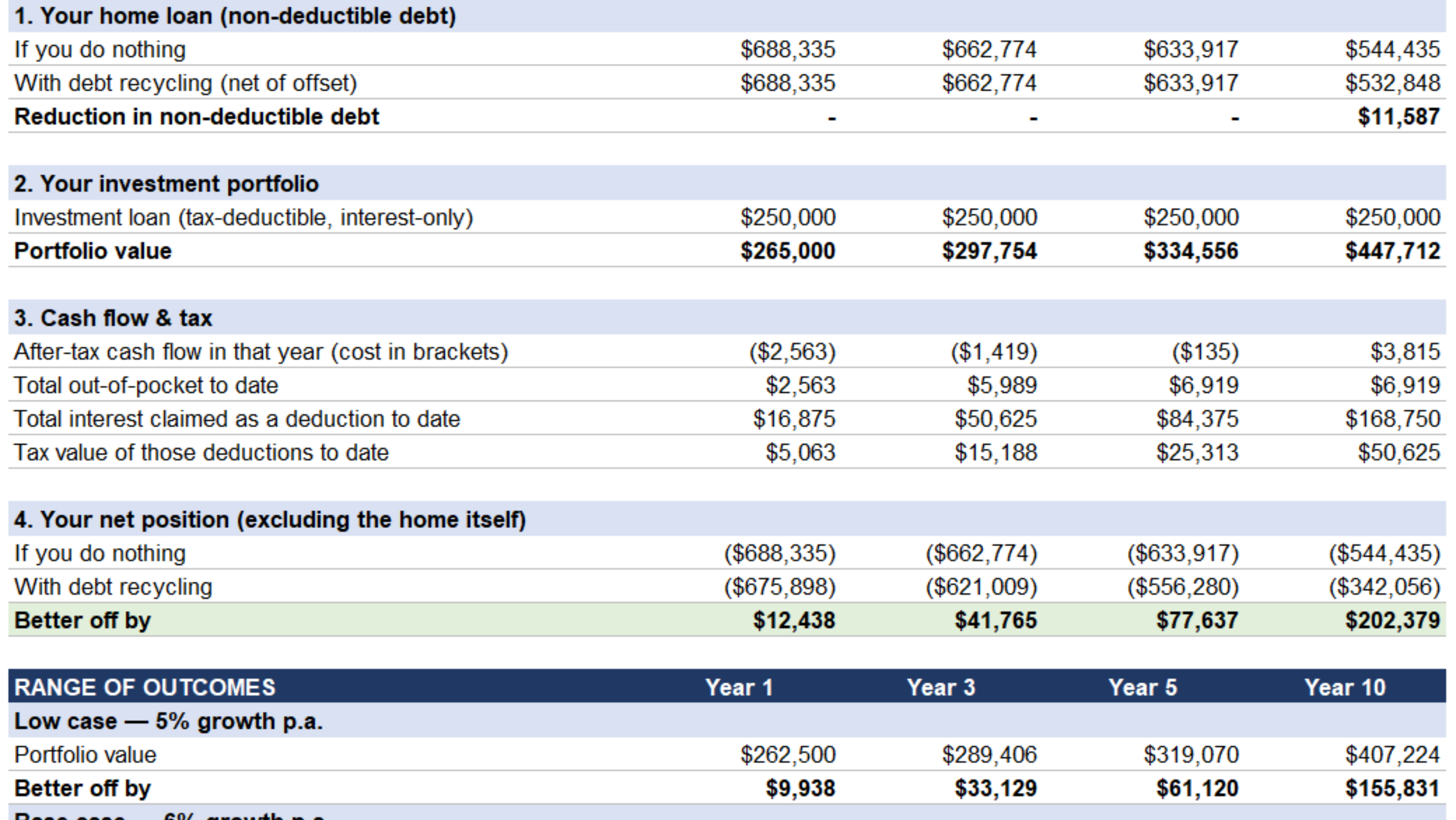
Adjust the figures to match your situation. The projection is illustrative only and assumes constant rates, yields and tax rates, which the real world does not provide.
Tax rates include the 2% Medicare levy. Assumes 75% franking, a 30-year P&I home loan, an interest-only split for the full period, and constant rates, yields and tax rates.
After 10 years your net position could be
compared with doing nothing, at growth p.a. Shown before capital gains tax, fees and brokerage.
Portfolio value, year 10
Interest claimed, 10 years
Your out-of-pocket cost
| Projection | Year 1 | Year 3 | Year 5 | Year 10 |
|---|
Net position = portfolio value less the investment loan, less the home loan net of offset, less your total out-of-pocket cost. A bracketed figure means the strategy is behind. Markets do fall, and this projection doesn't show that.
Want me to run this against your actual loan, income and lender policy?
Book a strategy callGeneral information only. Illustrative projections, not personal financial product or tax advice. Jeremy Harper is a Credit Representative (CRN 463430) of Mortgage Specialists Pty Ltd ACN 612 422 178, ACL 387025. Lending subject to lender approval.
Each of these is avoidable at setup and painful to fix afterwards.
Mixed with your salary before it reaches the investment, which makes the purpose harder to demonstrate.
A personal draw from the investment split means the interest has to be apportioned for the life of the loan.
It feels like discipline. It works against the strategy, because the non-deductible loan is the one you want to shrink.
Reducing deductible interest is worth less than reducing non-deductible interest.
The structure was right and the evidence is missing, which in practice is much the same problem.
Borrowing to invest magnifies both directions. If the investments fall, the debt does not. The deduction is certain. The return is not.
Borrowing to invest increases both potential gains and potential losses, and you remain liable for the debt regardless of how the investments perform. This page is general information only and is not financial product or tax advice.
Over 10 years in broking with a background in accounting. We handle the loan structure and work alongside your accountant and adviser, who handle the rest.
Book with Jeremy →Yes. It relies on ordinary deductibility rules: interest on money borrowed to produce assessable income is generally deductible. What matters is that the structure genuinely reflects that and you can demonstrate it. Your accountant should confirm the treatment for your circumstances.
In practice, yes. A single mixed loan can theoretically be apportioned, but it gets harder every year and leaves you relying on reconstruction rather than evidence.
Not for parking surplus cash you might want back for personal use. Money redrawn and spent personally is non-deductible borrowing, and if it comes from an otherwise deductible split you have created a mixed loan.
Then the product is not suited to the strategy, and the choice is between not doing it and refinancing to a lender that will.
If you are being advised on what to invest in, that is financial product advice and should come from someone licensed to give it. Your accountant handles the tax treatment. We handle the loan structure.
The idea, the numbers behind it, and the loan structure it depends on.
The idea in plain terms: turning non-deductible home loan debt into deductible investment debt, one round at a time.
Read more →
The mechanics, a worked example, and the risks stated plainly rather than buried under the tax benefit.
Read more →
Splits, redraw, offset placement and the five structural mistakes that cost people the deduction.
Read more →We will look at whether your current loan supports debt recycling, what it would cost to restructure, and which lenders handle splits and redraw well. Bring your accountant into the conversation early.
General information only. It is not credit, tax, financial or investment advice, and does not take into account your objectives, financial situation or needs. Borrowing to invest increases both potential gains and potential losses. Whether interest is deductible depends on the use of the borrowed funds and on your individual circumstances, and tax laws change. Lender features and policies on splits, redraw and offset accounts vary and change. Before acting, seek advice from a registered tax agent and a licensed financial adviser. Approval is subject to lender criteria, credit assessment and responsible lending obligations.
We use cookies to personalize content, provide social media features, and analyze our traffic. We also share information about your use of our site with our analytics partners. You can change your preferences at any time. For more information, please see our Privacy Policy and Cookie Policy. Privacy Policy Cookie Policy