
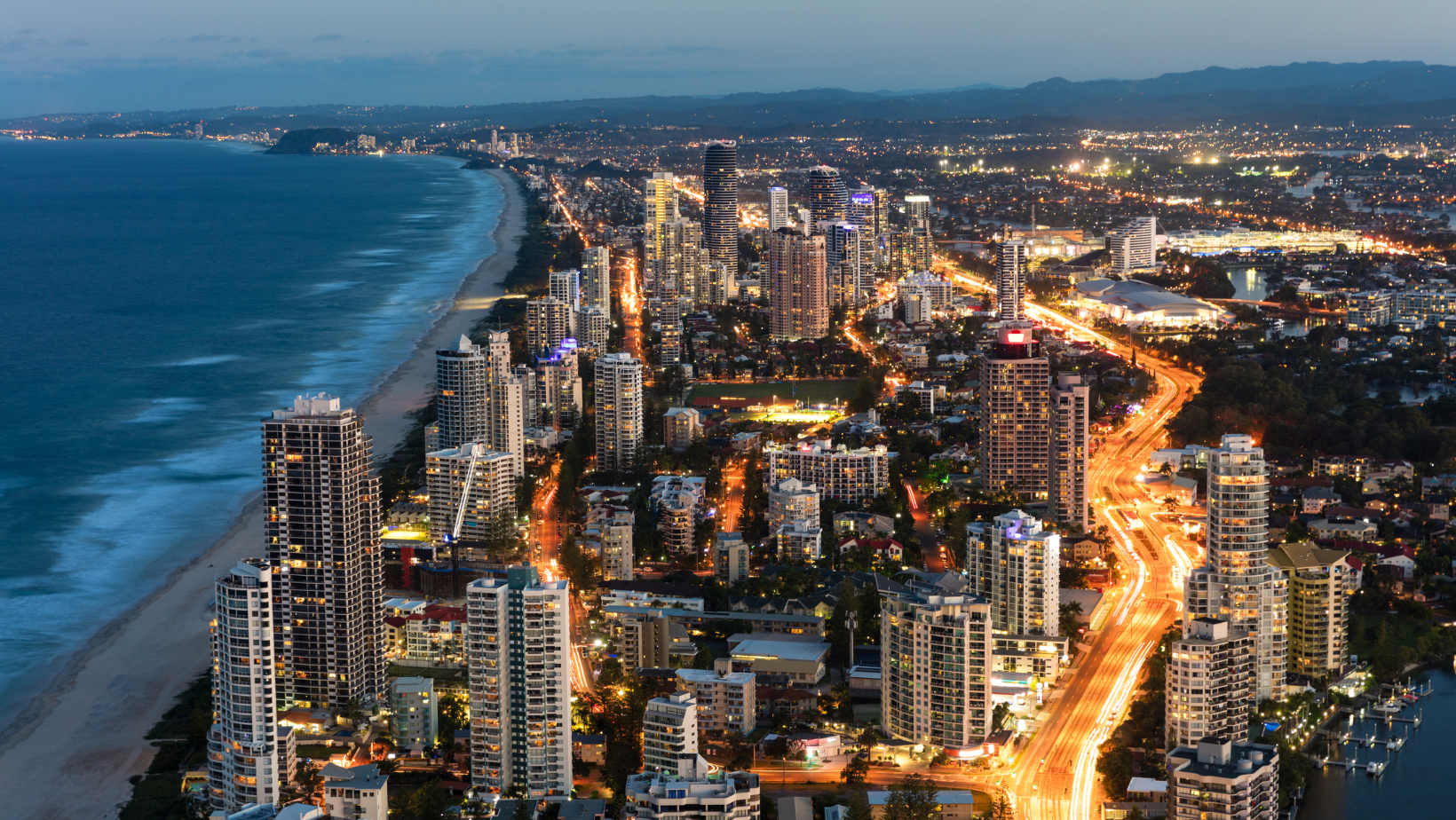
While property values eased across most of the country in July 2026, the Gold Coast quietly did the opposite. It’s a small move on paper, but it points to something bigger: a local market that increasingly runs on its own logic, detached from the usual capital city cycle. For anyone buying, selling, or holding property in the region, that shift is worth understanding properly rather than skimming past as a single month’s headline.
The July numbers
PropTrack’s Home Price Index for July 2026 showed the Gold Coast median rising 0.05% to reach $1.182 million, recovering the small dip recorded in June. Over the same month, Brisbane and the national average both fell 0.3% (NPA Projects). That’s a modest gap in isolation, but the direction matters more than the size: the Gold Coast moved up while two of its usual reference points moved down.
Kollosche managing director Michael Kollosche, one of the region’s most prominent agents, put it plainly: concerns over interest rates and the federal budget had created a short window of opportunity for buyers, but he expected that window to close quickly. His view was that the market has “turned into a solid market that is not really tied to any of the capital cities anymore” (NPA Projects). That’s a notable claim from someone selling in the market day to day, and it lines up with what the broader data has been showing for some time.
How the Gold Coast became Australia’s second most expensive market
The July figures aren’t a one-off. The Gold Coast has been closing the gap on Sydney for a couple of years now. Ray White’s chief economist Nerida Conisbee has tracked the region overtaking every other Australian city except Sydney on median house price, with growth outpacing the national average consistently enough that, if the trend held, the Gold Coast median could approach Sydney’s by 2027 (Smart Property Investment). Conisbee’s read on the driver is straightforward: a steady flow of buyers from Sydney and Melbourne, some downsizing, some keeping a city apartment and buying a larger home on the coast, treating the Gold Coast less like a holiday market and more like a genuine alternative capital.
The unit market has told an even sharper version of the same story. In late 2025, the Gold Coast’s median unit price climbed to $956,000, overtaking Sydney’s for the first time on record (Australian Property Update). Prestige coastal pockets like Main Beach, Burleigh Heads and Palm Beach led that move, but the underlying cause was the same one now showing up in the July house price data: not enough new supply to meet the demand arriving from elsewhere in the country.
The supply problem underneath it all
This is the part that explains why the Gold Coast keeps behaving differently from Brisbane and Sydney even when national sentiment turns cautious. Coastal land in the region is effectively built out, and new apartment approvals have been slowing under planning delays and rising construction costs. Industry reporting suggests apartment completions are on track to fall from close to 1,900 in 2025 to fewer than 100 by 2027, a drop of more than 90% in just two years (Which Real Estate Agent).
That kind of supply cliff doesn’t resolve itself quickly. When new stock isn’t coming onto the market at anywhere near the rate buyers are arriving, prices tend to stay firm even when the national mood softens, which is a reasonable explanation for why the Gold Coast posted a gain in the same month Brisbane and the national average both fell.
The rental market shows the same undersupply from a different angle. In April 2026, Domain reported the Gold Coast had overtaken Sydney as the country’s most expensive rental market by median asking rent, at $900 a week for houses compared to Sydney’s $750, even as rental growth elsewhere started to plateau under sheer affordability pressure (Domain). Domain’s chief of research Nicola Powell noted that low vacancy usually translates directly into rental growth, but that connection is loosening in the Gold Coast simply because tenants’ budgets are being pushed to their limit. That’s not a healthy dynamic for renters, but it is a clear signal of just how tight supply has become across the board, not only for buyers.
What this means depending on where you sit
None of this means the Gold Coast is immune to broader market forces. A single month of gains against a national dip isn’t proof of decoupling on its own, and the same undersupply that’s propping up prices also makes the market harder to enter, whether you’re buying your first home, upgrading, or adding to a portfolio.
If you’re a buyer, the practical implication is that waiting for a broader national slowdown to flow through to Gold Coast prices may not play out the way it has in other cities. Land scarcity in coastal corridors is pushing buyers further inland toward growth areas like Pimpama and Coomera, and that inland shift is itself becoming a trend worth watching rather than a fallback option.
If you’re an existing owner or investor, the tightening rental market and resilient price growth are generally supportive of your position, but it’s still worth having your lending reviewed regularly rather than assuming today’s structure remains the most efficient one as your equity position changes.
If you’re thinking about selling, current conditions, tight listings combined with steady buyer demand from interstate, have generally favoured sellers over the past year, though that can shift quickly if listing volumes rise or buyer sentiment cools further nationally.
The bottom line
The Gold Coast’s July result is a small number, up 0.05% against a national fall of 0.3%, but it’s consistent with a pattern that’s been building for a couple of years: chronic undersupply, strong interstate migration, and a market that increasingly sets its own pace rather than following Sydney, Melbourne or Brisbane. Whether that continues depends heavily on how quickly new supply can come online, and on where the broader interest rate environment heads from here.
If you’re weighing up a purchase, sale, or refinance on the Gold Coast and want to understand what current conditions actually mean for your specific numbers, get in touch with the hfinance team. We work across the Gold Coast and Sydney markets and can help you see where you genuinely stand before you make a move.
This article is general information only and does not take into account your personal financial situation or objectives. Speak with an hfinance broker before making any lending or property decisions.