
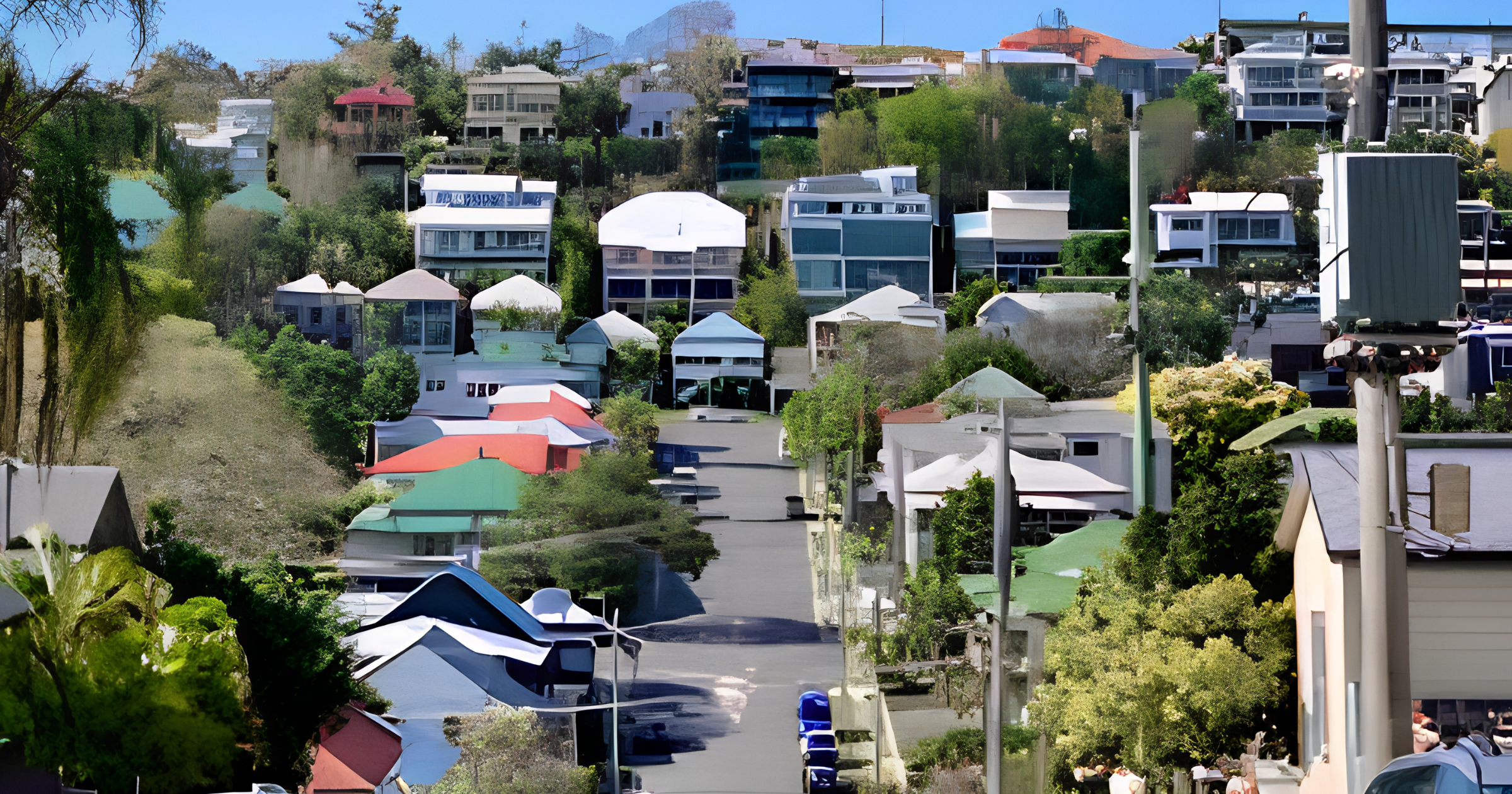
Paddington is one of the most expensive residential markets in the country, and buying here brings a set of finance issues that do not exist in the rest of Sydney. Loan sizes cross thresholds where lender policy changes. Heritage terraces value unpredictably. Yields are so low that servicing carries the entire deal. hfinance is based in the Inner West at Stanmore and we arrange loans across the Eastern Suburbs regularly.
About Paddington
Paddington sits 2.7 kilometres east of the Sydney GPO, bordered by Darlinghurst, Woollahra, Centennial Park and the Moore Park sporting precinct. It covers just 1.6 square kilometres. Oxford Street runs through the middle, the Sydney Cricket Ground and Allianz Stadium are on its western edge, and almost the entire suburb sits within a heritage conservation area.
The population is about 12,700 and it has fallen slightly down 1.6 per cent over five years. The dominant age group is 30 to 39, households are predominantly childless couples in professional occupations, and the Census records most mortgage-holding households here repaying more than $4,000 a month. Around 53 per cent of homes are owner-occupied and the average length of ownership is 13 years.
The housing stock is the defining feature: rows of Victorian terraces, most of them heritage-listed or within a conservation area, on small blocks with narrow frontages and frequently no off-street parking.
| Postcode | 2021 |
| Distance from Sydney GPO | 2.7 km |
| Suburb size | 1.6 sq km — 28 parks |
| Population | 12,700 (down 1.6% over five years) |
| Dominant age group | 30–39 years |
| Owner-occupied | About 53% |
| Average length of ownership | 13 years |
| Property types | Heritage terraces, semis, boutique apartments |
Source: Cotality Suburb Profile Report, Paddington NSW 2021, August 2026. Population and household figures based on the 2021 Census.
What Paddington Property Is Worth
The house market here operates at a level that changes how lenders assess an application. The median sale price is $3.6 million and the upper quartile approaches $5 million.
| Houses | Units | |
| Median value | $3,504,676 | $1,120,110 |
| Median sale price (12 months) | $3,600,000 | $981,000 |
| Lower quartile | $2,667,500 | $821,000 |
| Upper quartile | $4,925,000 | $1,480,000 |
| Total dwellings | 4,070 | 2,539 |
| New listings (12 months) | 158 | 62 |
Source: Cotality Suburb Profile Report, August 2026. Median sale price, quartiles and listing counts calculated over a rolling 12-month period.
Even the lower quartile at $2.67 million sits above the point where several lenders reduce their maximum loan-to-value ratio. That is not a detail — it is the central planning question for a Paddington purchase.
The unit market is a different world entirely, from around $820,000 at the lower quartile to $1.48 million at the upper. Boutique apartments and converted terraces make up most of it, and there is very little of the large-complex stock that attracts high-density lender restrictions.
The Rental Picture
Paddington house rents run around $1,450 to $1,500 a week, with larger terraces asking $2,290 and above. Unit rents sit near $720.
Gross yields are the lowest in this series by a wide margin roughly 2.25 per cent on houses and about 3.4 per cent on units. On a $3.6 million house, a 2.25 per cent yield produces around $78,000 a year against interest costs many multiples of that. Paddington is not an income market under any circumstances. Every investment case here rests on capital growth and on the buyer’s capacity to fund a substantial shortfall indefinitely.
The Rate Environment in 2026
The Reserve Bank has tightened through 2026. The cash rate rose in three steps February, March and May from 3.60 per cent to 4.35 per cent, unwinding the cuts delivered in 2025, and the Board held at 4.35 per cent in June. Average new owner-occupier variable rates have been sitting in the low-to-mid 6 per cent range, with investor rates roughly 15 to 20 basis points higher.
That matters for borrowing capacity more than for repayments. Lenders assess your ability to repay at around three percentage points above the actual rate, so a borrower being assessed today is being tested at close to 9.5 per cent. Capacity has fallen through 2026 even for buyers whose income has risen.
Practically, it means two things. If you hold a pre-approval issued before this year, the numbers behind it are out of date and it should be reassessed. And if you are comparing fixed against variable, fixed pricing moves on expectations rather than on cash rate decisions, so it can shift within days of an RBA statement without the cash rate changing at all.
Cash rate: 4.35%
Latest RBA decision: Held unchanged on 11 August 2026
Sydney annual dwelling value change: −2.0%
Source: Reserve Bank of Australia, August 2026; Cotality Monthly Housing Chart Pack, August 2026.
Financing in Paddington: Loan Size and Heritage
Two issues dominate, and both need addressing before you start bidding.
The first is loan size. Once a loan passes roughly $2 million, lender policy tightens. Maximum LVRs typically step down often to 80 per cent, sometimes lower as the amount rises — and above about $2.5 million many lenders require credit approval outside standard policy, which takes longer and comes with more conditions. At Paddington price points you are frequently borrowing $2 million to $3 million, and the lender who offers the sharpest advertised rate on a $700,000 loan may not be competitive, or even willing, at that level. Large-loan lending is a genuinely different market and it rewards knowing which lenders actively want the business.
Servicing at these levels also works differently. Lenders assess your repayments at around three percentage points above the actual rate. With variable rates in the low-to-mid six per cent range, that means a $2.5 million loan is assessed at roughly nine and a half per cent — repayments well over $20,000 a month on paper. Bonus income, equity vesting, trust distributions and self-employed earnings are all common in this market, and lenders treat each of them differently. How that income is presented determines the outcome more than the headline figures do.
The second issue is the property itself. A heritage terrace in a conservation area is harder to value than a standard house because the comparable sales are rarely comparable frontage width, whether the rear has been extended, parking, aspect and condition create wide variation on the same street. Valuations come back with more spread here than almost anywhere in Sydney, and on a $3 million purchase a five per cent valuation gap is $150,000 in additional deposit.
Heritage status also constrains what you can do afterwards. If your plan involves renovating or extending, the lender will want to see approved plans before funding the work, and conservation-area consent takes time. Anyone considering a renovation loan should establish what council will actually permit before assuming a construction facility is available.
A practical note on process: much of the Eastern Suburbs still transacts at auction, and an auction purchase is unconditional. There is no finance clause and no cooling-off. Formal pre-approval, with the valuation risk understood in advance, is not a nice-to-have in this market.
How hfinance Can Help
We know which lenders compete properly above $2 million and which quietly step back, and we structure applications so complex income bonuses, equity, trust distributions, self-employment is presented the way credit teams need to see it. On heritage stock we plan for valuation variance rather than being surprised by it, and we make sure your pre-approval is solid before you raise your hand at an auction.
This article contains general information only and does not take into account your objectives, financial situation or needs. Consider whether it is appropriate for your circumstances and seek professional advice before making any financial decisions.
Jeremy Harper, Credit Representative CRN 463430 of Mortgage Specialists Pty Ltd ACL 387025