
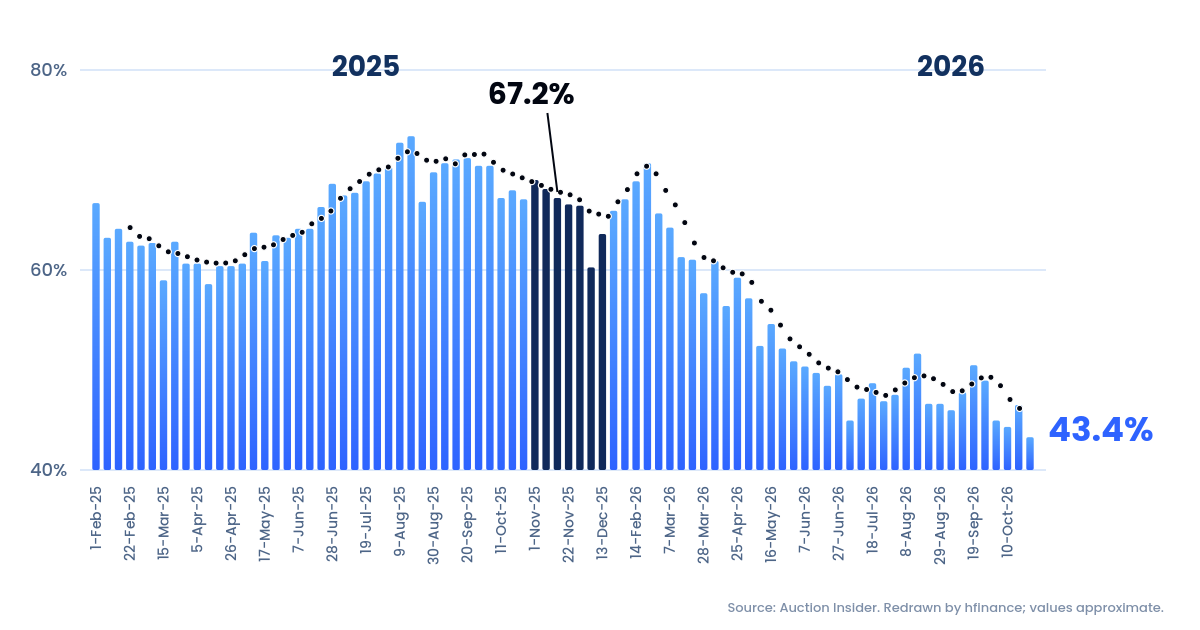
Every Sunday, the property headlines tell you what percentage of homes sold at auction over the weekend. By Thursday, that number has often changed.
Take the week ending 11 October. Cotality’s preliminary combined capital city clearance rate on Sunday was 48.8%. By the time the final figure came out, it was 44.1% (Capital Brief). That’s a gap of 4.7 percentage points, and it matters if you’re trying to read the market.
This guide explains how auction clearance rates are calculated, why the number moves, and what it means if you’re thinking about buying at auction.
What a clearance rate measures
A clearance rate is the share of auctions that end in a sale. Different data providers calculate it slightly differently, so it helps to know the method behind the number you’re reading.
Cotality, the most widely quoted source, calculates its weekly rate using the total known number of properties sold before, at or after auction, against the total known number of auction results, including passed-in and withdrawn auctions (Cotality). Three things to note:
- Passed-in and withdrawn auctions count as no sale. That’s why clearance rates can sit well below 50% in a weaker market.
- Only known results are counted. The rate is based on the results the provider has collected, not every scheduled auction.
- Small samples are unreliable. Cotality treats any rate based on fewer than 10 collected results as statistically unreliable, which is why you’ll rarely see a meaningful clearance rate for cities where few homes sell at auction.
Other providers use different rules. SQM Research, for example, counts properties sold before or at auction against all scheduled auctions, and treats withdrawn properties and those sold after the auction as passed in (SQM Research). That’s why Cotality’s numbers shouldn’t be compared directly with another provider’s.
Why Sunday’s number changes
Cotality publishes a preliminary rate on Sunday, using the results collected by then, and a final rate in its auction market preview each Thursday as the remaining results come in. Cotality notes the preliminary results are provisional, with final rates published later in the week.
The pattern in recent weeks is that the final number comes in lower:
| Week ending | Sunday (preliminary) | Final | Change |
|---|---|---|---|
| 4 October | 48.2% | 45.4% | down 2.8 points |
| 11 October | 48.8% | 44.1% | down 4.7 points |
Sources: Cotality figures as reported by Capital Brief and Cotality’s finalised clearance rate reports.
It’s not unique to October. SQM Research notes that its peers often produce a preliminary rate that is revised, often lower, some days later (SQM Research). In June, when Cotality reported a preliminary clearance rate of 49.2%, it estimated the figure would fall further once all results were counted, likely closer to 40% (ABC News).
How to read a clearance rate headline
A few habits make the numbers more useful:
- Compare like with like. Compare one week’s preliminary rate with another week’s preliminary rate, and final with final. Putting this week’s preliminary figure next to last week’s final one mixes up two stages of collection.
- Check the number of auctions. A clearance rate on 1,200 auctions says more than one on 300. Auction volumes have been well down this spring.
- Look at the trend. The four-week average smooths out weekly swings, such as long weekends or major events.
- Remember which cities it covers. Sydney and Melbourne hold most of the auctions. Elsewhere, fewer homes sell at auction, so clearance rates there are a thinner signal.
- Treat it as context, not a forecast. A clearance rate says how auctions went last week. It isn’t a valuation or a prediction of where prices will go.
What the recent numbers show
Clearance rates have been under pressure since the RBA lifted the cash rate to 4.60% on 29 September. Cotality economist Annabelle Mezieres said the increase likely contributed to the weaker results, as buyers faced reduced borrowing capacity and subdued confidence (Capital Brief).
The final combined capital city rate was 45.4% for the week ending 4 October, the lowest since July, and 44.1% a week later. In Melbourne, the final rate for the week ending 11 October was 49.8%, compared with 68.6% in the same week last year, with auction numbers down around 44%, according to reporting of Cotality’s figures.
If you want the wider picture, our look at why Australian home values fell 1.1% covers what the slowdown means for borrowers.
If you’re buying at auction
A softer auction market can mean more room to negotiate, but the rules of buying at auction don’t change. Four points matter most.
The sale is unconditional. When you’re the winning bidder, you sign a contract on the same terms that were displayed before the auction. You can’t make it subject to finance, and there’s no cooling-off period (Consumer Affairs Victoria). The detail varies by state, so check the rules where you’re buying.
You pay a deposit on the day. There’s no set amount in Victoria, but it’s usually 10% of the price, so be ready to pay it.
A pre-approval isn’t enough. A pre-approval tells you roughly what a lender may lend, but it’s conditional. Before you bid, you want formal approval for the specific property, up to your maximum bid. A pre-approval can also lapse, and most last around 90 days.
Valuation risk is yours. The lender values the property independently. If the valuation comes in under the price you paid, you cover the gap in cash. In a falling market, that risk is higher. We cover how it works in our Stanmore guide.
A checklist before you bid
- Get the contract and send it to your lender or broker well before auction day.
- Ask for formal approval, not just a pre-approval, up to your maximum bid.
- Check your borrowing capacity at today’s rates, remembering lenders assess at 3 percentage points above the actual rate (APRA). Our home loan calculator is a quick starting point.
- Have your deposit and costs ready. Use our guide to stamp duty by state to budget for duty, and check our first home buyers page for schemes.
- Set a firm limit and stick to it.
- Have a solicitor or conveyancer review the contract before you bid.
What to watch next
Cotality publishes preliminary auction results on Sunday and Monday, with final rates in its auction market preview on Thursdays. The RBA’s next decision is on 3 November, and Cotality’s October index is due in early November.
Talk to us before you bid
If you’re considering an auction, the hfinance team can check your finance is properly in place before you raise your hand. We compare across 50+ lenders and can tell you your realistic limit, and how a valuation shortfall would affect you. Get in touch before auction day, not after.
This article is general information only and does not take into account your personal financial situation or objectives. Auction rules and cooling-off arrangements differ between states, so check the rules where you’re buying and get legal advice on the contract. Clearance rate figures are as reported at the time of writing and can change. Speak with an hfinance broker before making any lending decisions.